Water Quality Survey
Arriving to Site
Once you arrive, the team will go through a site risk assessment to check for any potential hazards (like slippery rocks or strong currents). You’ll be shown the safest places to stand and collect samples. Make sure you’re wearing sunscreen, a hat, and weather-appropriate clothes (there will be waders for you to use whilst sampling).
How to collect a Water Quality Sample
When collecting a water quality sample, it’s important to choose a representative spot in the waterway, avoid stagnant pools or riffles if possible. Try to take your sample at a depth of 30cm below the surface, as the top layer of water is often not a true reflection of overall water quality. We take 3 samples to test for nutrients, total nitrogen and soluble nitrogen. This is then sent to the lab to be tested!
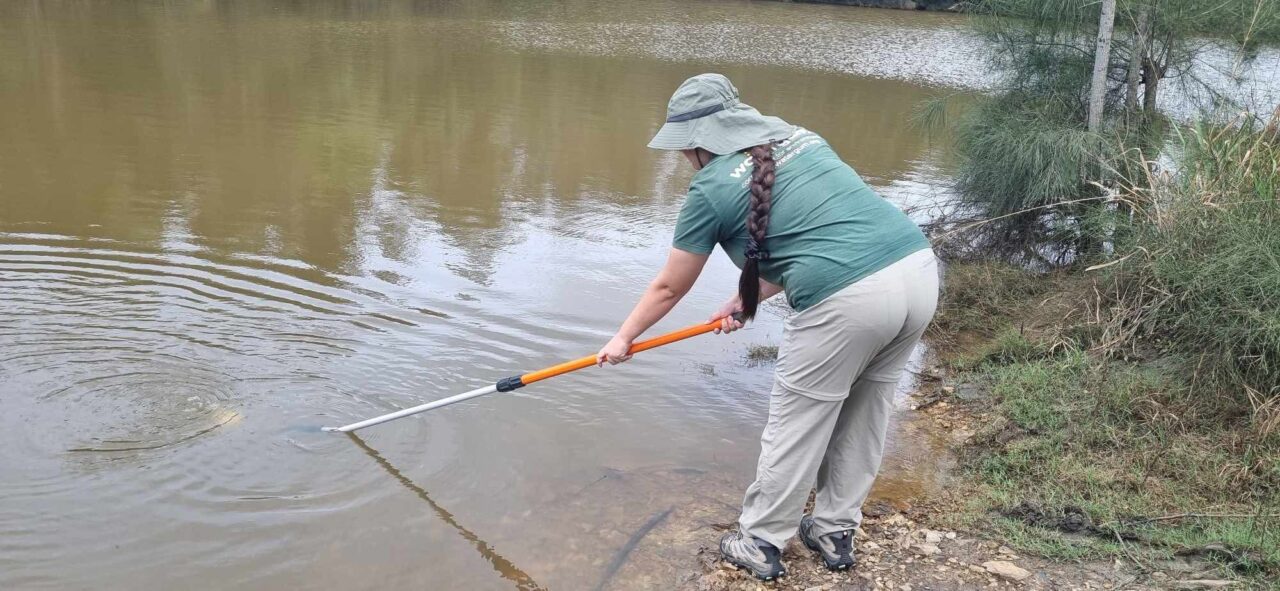
How to collect a Water Quality Reading
We gather water quality readings using our specialised monitoring device, the Aqua Troll. This tool allows us to collect accurate data on several important waterway health indicators, including pH, conductivity, salinity, total dissolved solids, turbidity, dissolved oxygen, oxygen reduction potential, and temperature. By measuring these parameters, we can better understand the overall condition of the water and detect any potential issues.
pH – Tells us how acidic or alkaline the water is. Most freshwater creatures prefer a pH between 6.5 and 8.5.
Conductivity – Measures how well water can carry an electrical current, which reflects the amount of dissolved salts and minerals.
Salinity – Shows how salty the water is. Freshwater has low salinity, while higher levels can indicate pollution or saltwater intrusion.
Total Dissolved Solids (TDS) – Represents all the dissolved substances in the water. High TDS can affect aquatic life and water clarity.
Turbidity – Measures how cloudy the water is. Cloudiness is usually caused by sediment or algae and can reduce sunlight and harm habitats.
Dissolved Oxygen (DO) – Indicates how much oxygen is available in the water for aquatic life. Low DO can stress or kill animals.
Oxygen Reduction Potential (ORP) – Shows the water’s ability to break down waste and pollutants. A healthy ORP means better self-cleaning water.
Temperature – Affects how much oxygen water can hold and influences the types of species that can survive in the environment.
